


Most people assume laws run the show. Write the rules down, enforce them equally, and everyone plays by the same standards — that’s the deal, right? But look closely at how power actually works, and you’ll start noticing cracks in that story pretty fast.
This breakdown is for anyone who’s ever felt like the system bends differently depending on who you are, who you know, or how much money sits in your account. Whether you’re a civics nerd, a skeptical voter, or just someone who wants to understand why justice doesn’t always look equal, this is worth your time.
Here’s what we’re getting into:
- What the rule of law actually promises — and where that promise comes from
- Why the rule of men keeps sneaking back in, even inside systems built to stop it
- How this plays out in your real, everyday life — not just in courtrooms or history books
The gap between how governance should work and how it actually works is where things get interesting. Let’s dig in.
Understanding the Rule of Law and What It Promises
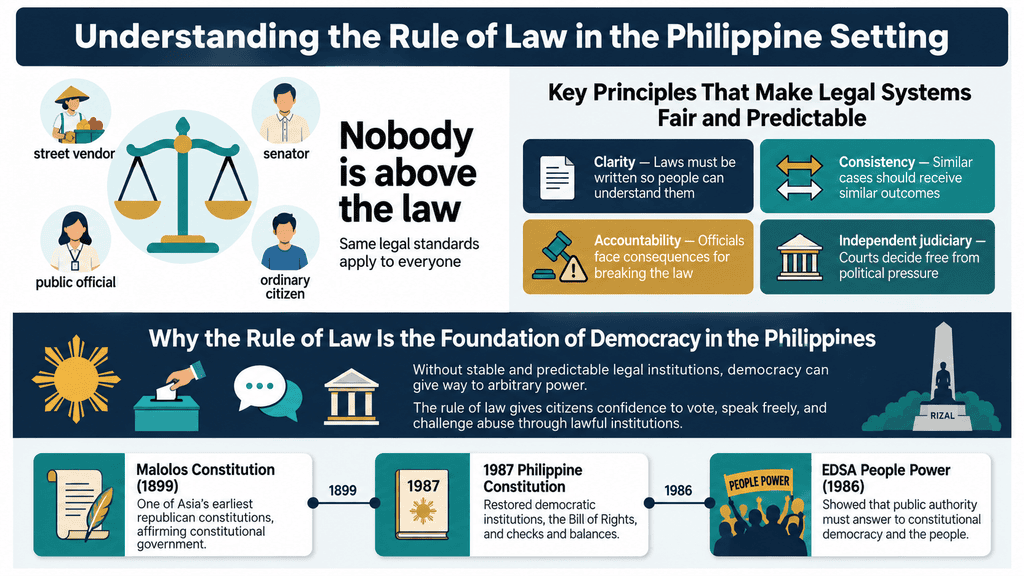
How the Rule of Law Creates Equal Standards for Everyone
The rule of law works on one core promise: nobody is above the law. Whether you’re a street vendor or a senator, the same legal standards apply. This levels the playing field and prevents powerful individuals from simply doing whatever they want without consequences.
Key Principles That Make Legal Systems Fair and Predictable
A functioning rule of law rests on a few non-negotiables:
- Clarity – Laws must be written so people can actually understand them
- Consistency – Similar cases get similar outcomes
- Accountability – Officials face consequences for breaking the law
- Independent judiciary – Courts operate free from political pressure
Why the Rule of Law Is Considered the Foundation of Democracy
Without predictable legal structures, democracy collapses into whoever holds power today making the rules for tomorrow. Legal governance gives citizens the confidence to vote, speak freely, and challenge authority — because they trust the system has their back.
Historical Moments That Shaped Our Belief in Legal Governance
| Moment | Impact |
|---|---|
| Malolos Constitution (1899) | One of Asia’s earliest republican constitution affirming constitutional government |
| EDSA People Power Revolution (1986) | Restored democratic institution and reaffirmed that public power must answer to the people |
| 1987 Philippine Constitution | Strengthened Bill of Rights, separation of powers, and judicial independence |
Defining the Rule of Men and Why It Persists
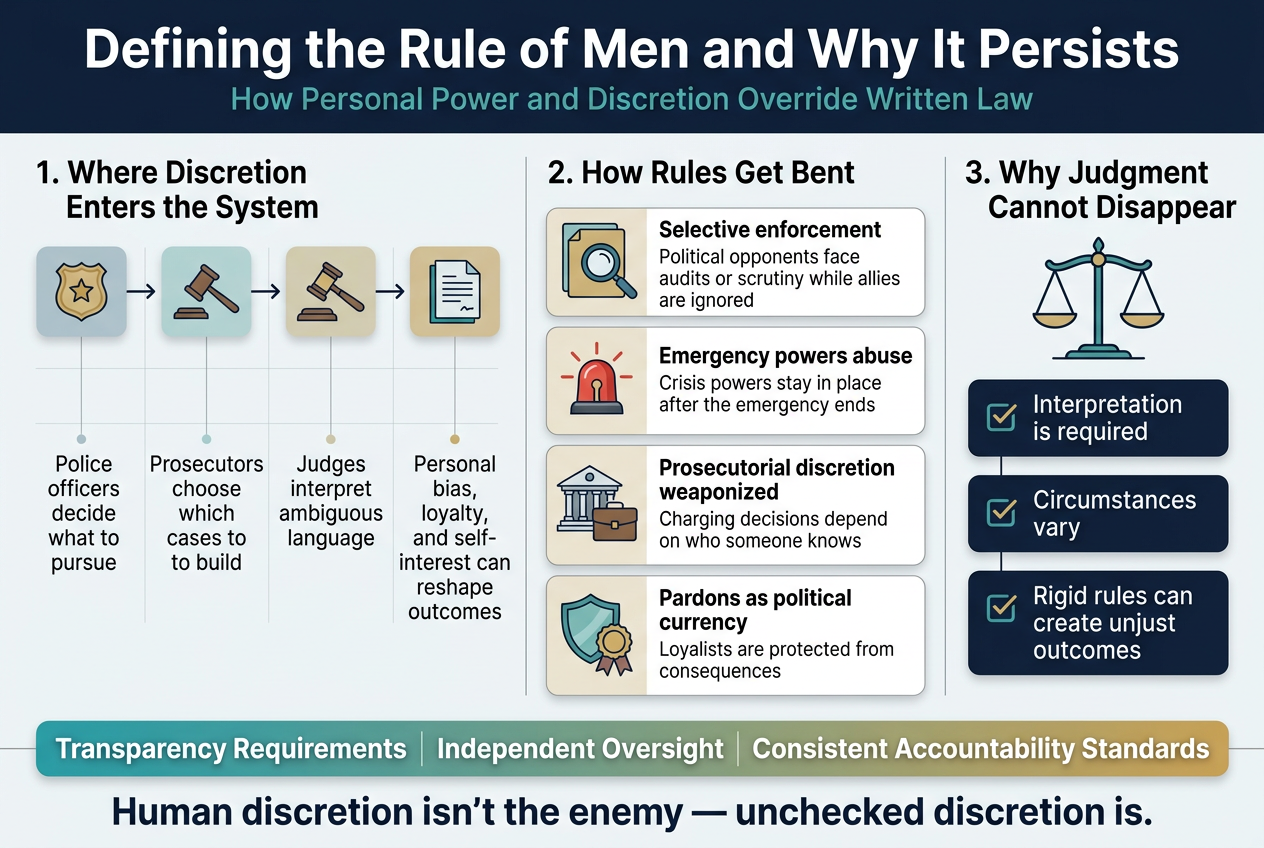
How Personal Power and Discretion Override Written Law
Laws don’t enforce themselves. Every statute, regulation, and court ruling passes through human hands before it affects anyone’s life. Police officers decide which violations to pursue. Prosecutors choose which cases to build. Judges interpret ambiguous language. Each decision point is an opening where personal bias, loyalty, or self-interest can quietly reshape what the law actually does.
Real-World Examples of Leaders Bending Rules to Suit Their Interests
History offers no shortage of examples:
- Selective enforcement: Governments targeting political opponents with tax audits or regulatory scrutiny while ignoring allies committing identical acts
- Emergency powers abuse: Leaders using crisis legislation to sidestep legislative oversight long after genuine emergencies passed
- Prosecutorial discretion weaponized: Charging decisions made based on who someone knows rather than what they did
- Pardons as political currency: Executives protecting loyalists from consequences that ordinary citizens would face
Why Human Judgment Can Never Be Fully Removed From Governance
No legal system can eliminate human judgment — nor should it try. Laws require interpretation. Circumstances vary. Rigid, mechanical application often produces outcomes that are technically correct but deeply unjust.
The real challenge is constraining that judgment through:
- Transparency requirements
- Independent oversight
- Consistent accountability standards
Human discretion isn’t the enemy — unchecked discretion is.
Where the Two Systems Clash in Modern Society
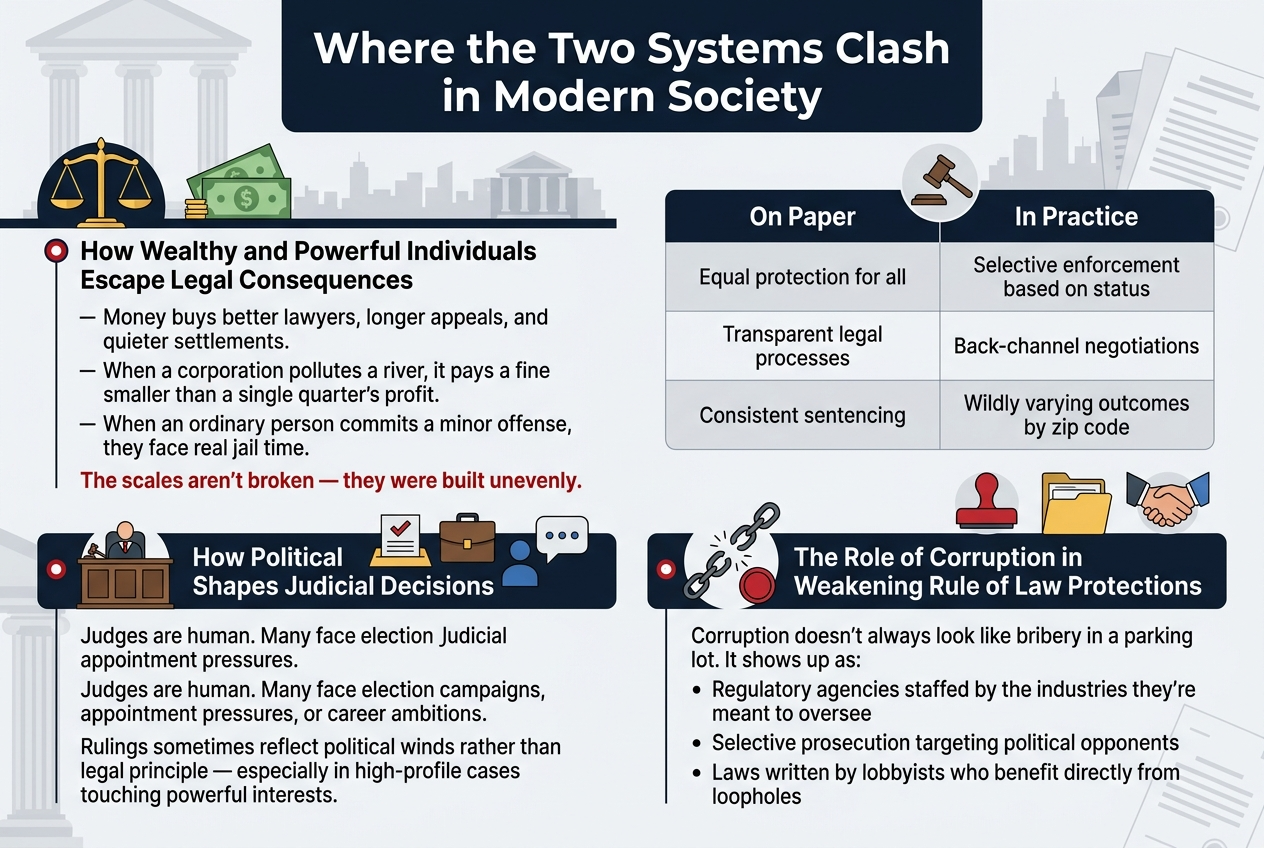
How Wealthy and Powerful Individuals Escape Legal Consequences
Money buys better lawyers, longer appeals, and quieter settlements. When a corporation pollutes a river, it pays a fine smaller than a single quarter’s profit. When an ordinary person commits a minor offense, they face real jail time. The scales aren’t broken — they were built unevenly.
The Gap Between Laws on Paper and Laws in Practice
| On Paper | In Practice |
|---|---|
| Equal protection for all | Selective enforcement based on status |
| Transparent legal processes | Back-channel negotiations |
| Consistent sentencing | Wildly varying outcomes by zip code |
Laws mean little if enforcement is inconsistent. The same statute can destroy one person’s life while barely inconveniencing another.
How Political Influence Shapes Judicial Decisions
Judges are human. Many face election campaigns, appointment pressures, or career ambitions. Rulings sometimes reflect political winds rather than legal principle — especially in high-profile cases touching powerful interests.
The Role of Corruption in Weakening Rule of Law Protections
Corruption doesn’t always look like bribery in a parking lot. It shows up as:
- Regulatory agencies staffed by the industries they’re meant to oversee
- Selective prosecution targeting political opponents
- Laws written by lobbyists who benefit directly from loopholes
Hidden Ways the Rule of Men Shapes Your Daily Life
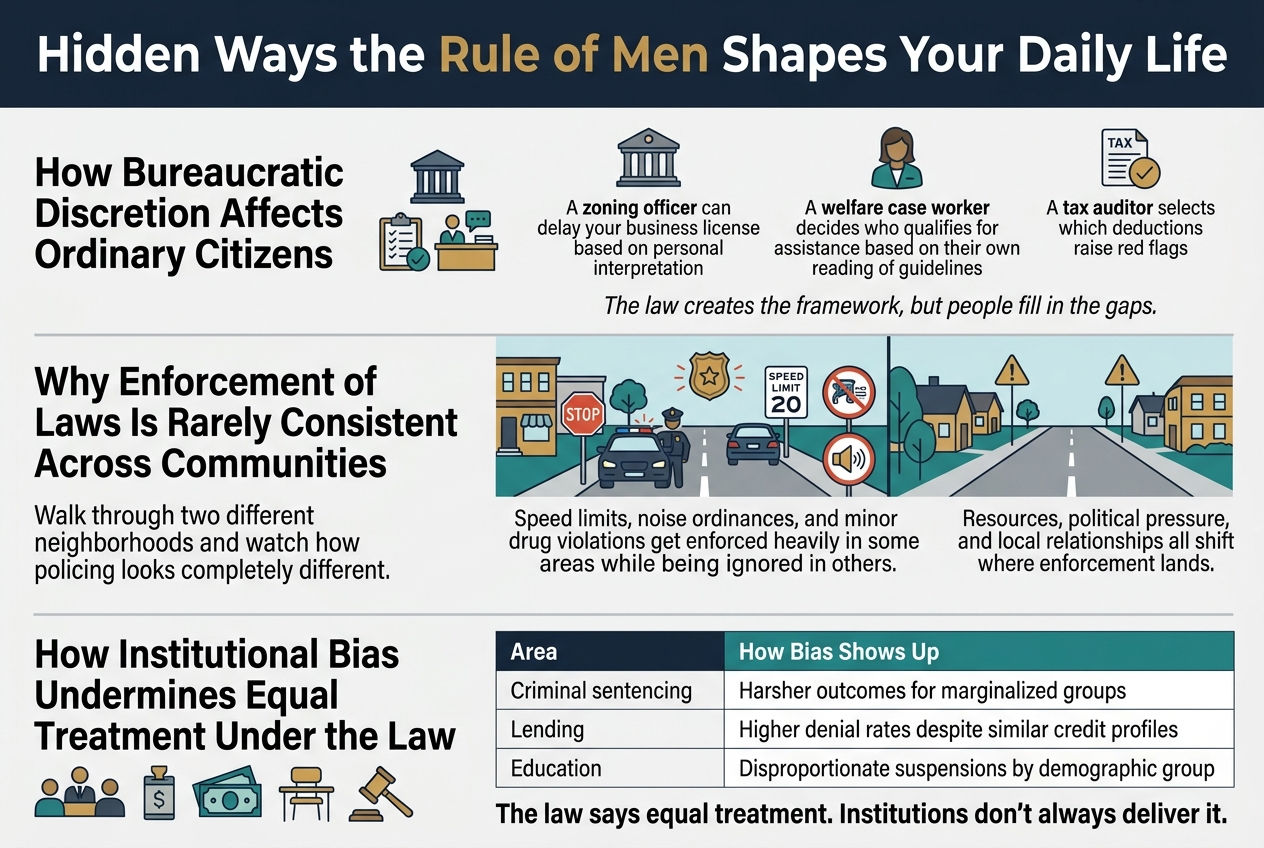
How Bureaucratic Discretion Affects Ordinary Citizens
Government officials make judgment calls every single day that directly affect your life — whether a permit gets approved, how quickly a complaint gets processed, or which violations get flagged. These decisions rarely follow a clear script.
- A zoning officer can delay your business license based on personal interpretation
- A welfare case worker decides who qualifies for assistance based on their own reading of guidelines
- A tax auditor selects which deductions raise red flags
The law creates the framework, but people fill in the gaps.
Why Enforcement of Laws Is Rarely Consistent Across Communities
Walk through two different neighborhoods and watch how policing looks completely different. Speed limits, noise ordinances, and minor drug violations get enforced heavily in some areas while being ignored in others. Resources, political pressure, and local relationships all shift where enforcement lands.
How Institutional Bias Undermines Equal Treatment Under the Law
Bias doesn’t always wear an obvious face. It lives inside hiring panels, loan approval systems, school discipline records, and courtroom sentencing patterns.
| Area | How Bias Shows Up |
|---|---|
| Criminal sentencing | Harsher outcomes for marginalized groups |
| Lending | Higher denial rates despite similar credit profiles |
| Education | Disproportionate suspensions by demographic group |
The law says equal treatment. Institutions don’t always deliver it.
Strengthening the Rule of Law to Protect Individual Rights
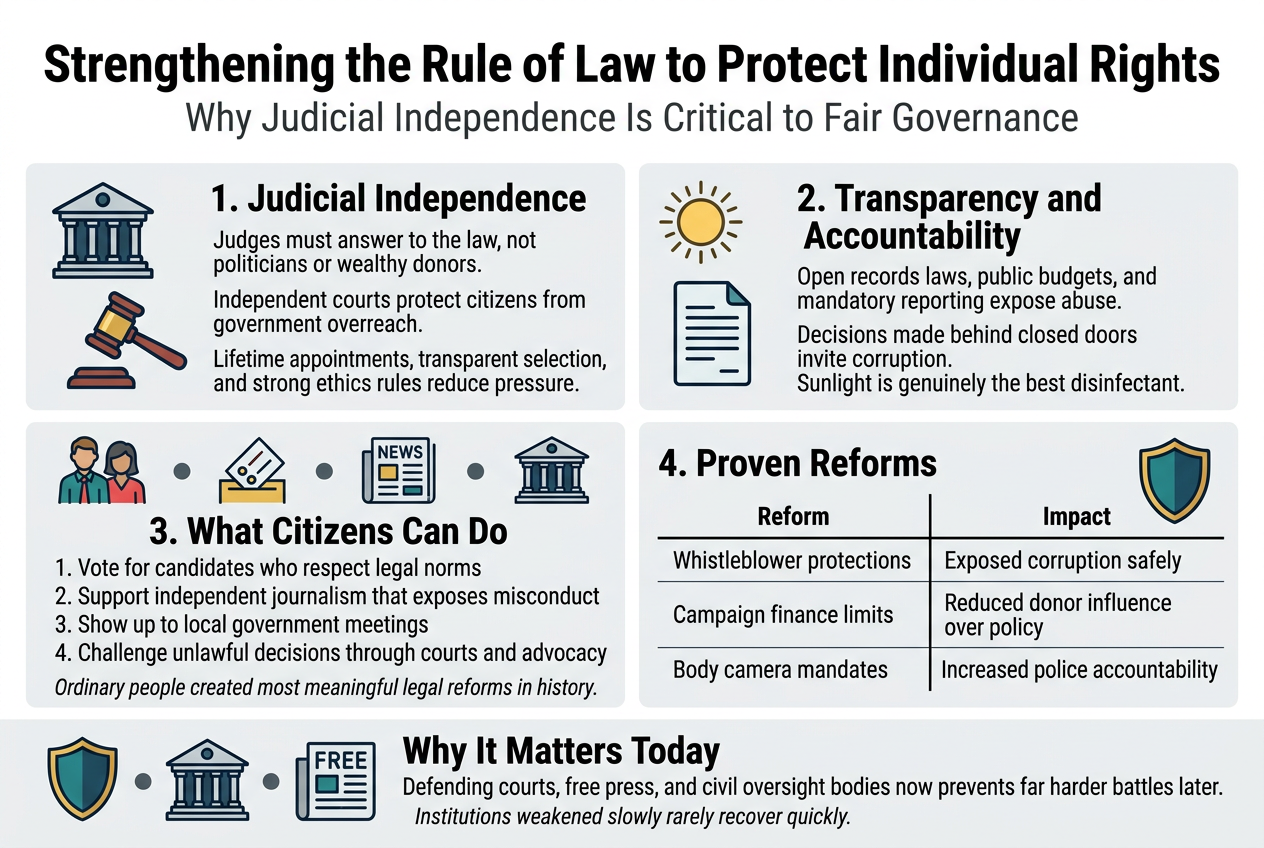
Why Judicial Independence Is Critical to Fair Governance
When judges answer to politicians or wealthy donors, justice bends toward whoever holds power. Independent courts act as the last line of defense between citizens and government overreach. Lifetime appointments, transparent selection processes, and strong ethics rules help keep courts free from political pressure.
How Transparency and Accountability Reduce the Abuse of Power
Sunlight is genuinely the best disinfectant. Open records laws, public budgets, and mandatory reporting force officials to operate where everyone can see them. When decisions happen behind closed doors, abuse quietly follows.
The Role Citizens Play in Demanding Consistent Legal Standards
- Voting for candidates who respect legal norms
- Supporting independent journalism that exposes misconduct
- Showing up to local government meetings
- Challenging unlawful decisions through courts and advocacy
Ordinary people created most meaningful legal reforms in history. Passive acceptance is what allows unequal enforcement to thrive.
Proven Reforms That Have Successfully Curbed Unchecked Authority
| Reform | Impact |
|---|---|
| Whistleblower protections | Exposed corruption safely |
| Campaign finance limits | Reduced donor influence over policy |
| Body camera mandates | Increased police accountability |
Why Protecting Legal Institutions Matters More Than Ever Today
Institutions weakened slowly rarely recover quickly. Defending courts, free press, and civil oversight bodies now prevents far harder battles later.
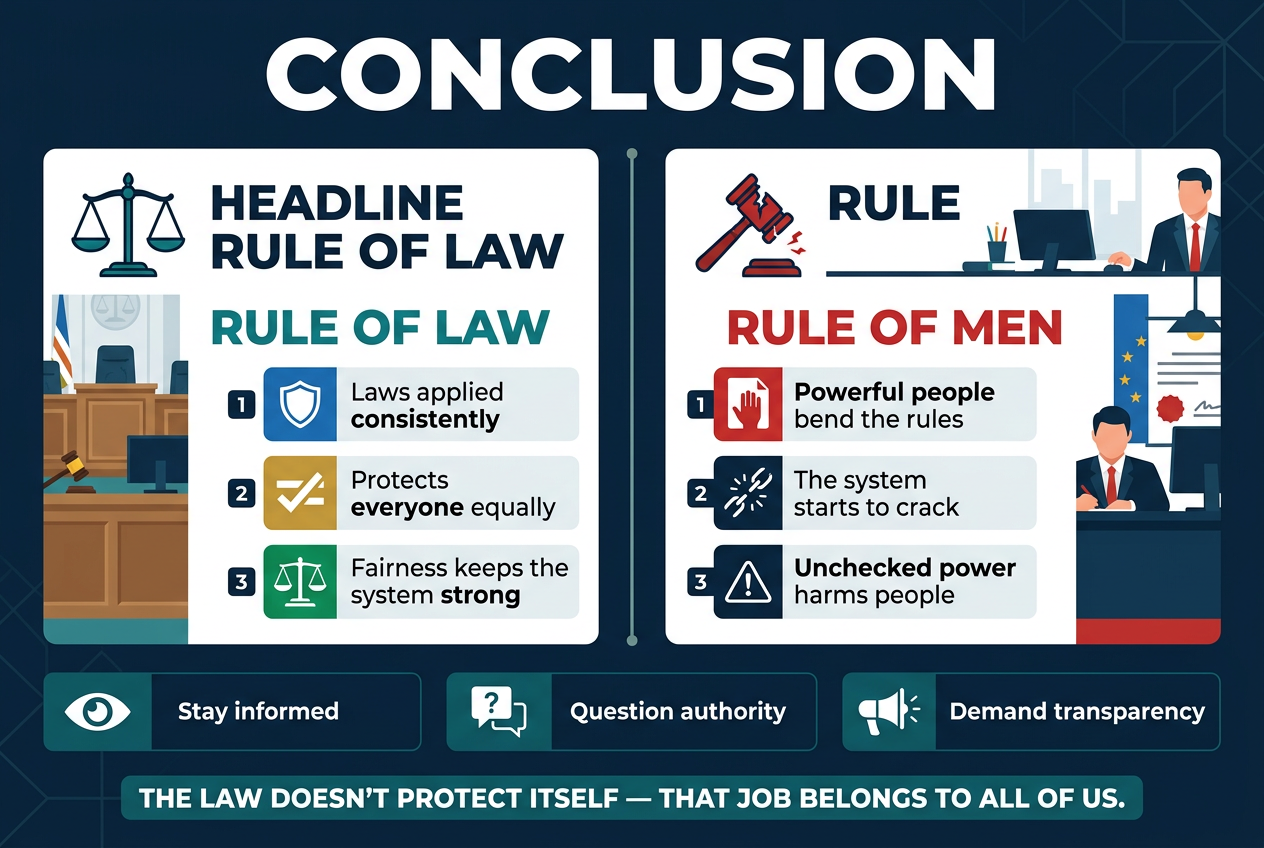
The tension between rule of law and rule of men isn’t just a political theory debate — it plays out in courtrooms, government offices, and everyday decisions that affect real people. When laws are applied consistently and fairly, they protect everyone equally. But when powerful individuals bend or bypass those laws, the whole system starts to crack. The line between the two can be razor-thin, and recognizing that line is the first step toward holding the right people accountable.
Staying informed, questioning authority, and demanding transparency from leaders and institutions are some of the most practical ways to push back against unchecked power. The rule of law only works when people actually fight to keep it alive. So pay attention to how decisions get made around you, speak up when something feels off, and never assume that the law protects itself — because it doesn’t. That job belongs to all of us.
The opposite of the rule of law is not human judgment. Law has always required human judgment. The opposite of the rule of law is arbitrary judgment — power that needs no reason beyond the will of the person exercising it.
A society governed by law therefore asks more than whether rules exist. It asks whether those who wield power are themselves constrained by rules; whether similar cases receive principled treatment; whether decisions can be explained by reasons rather than relationships; and whether even the powerful must answer to a standard they did not create for themselves.
The question is not whether men and women govern us. They inevitably do. The question is whether they govern under law.