

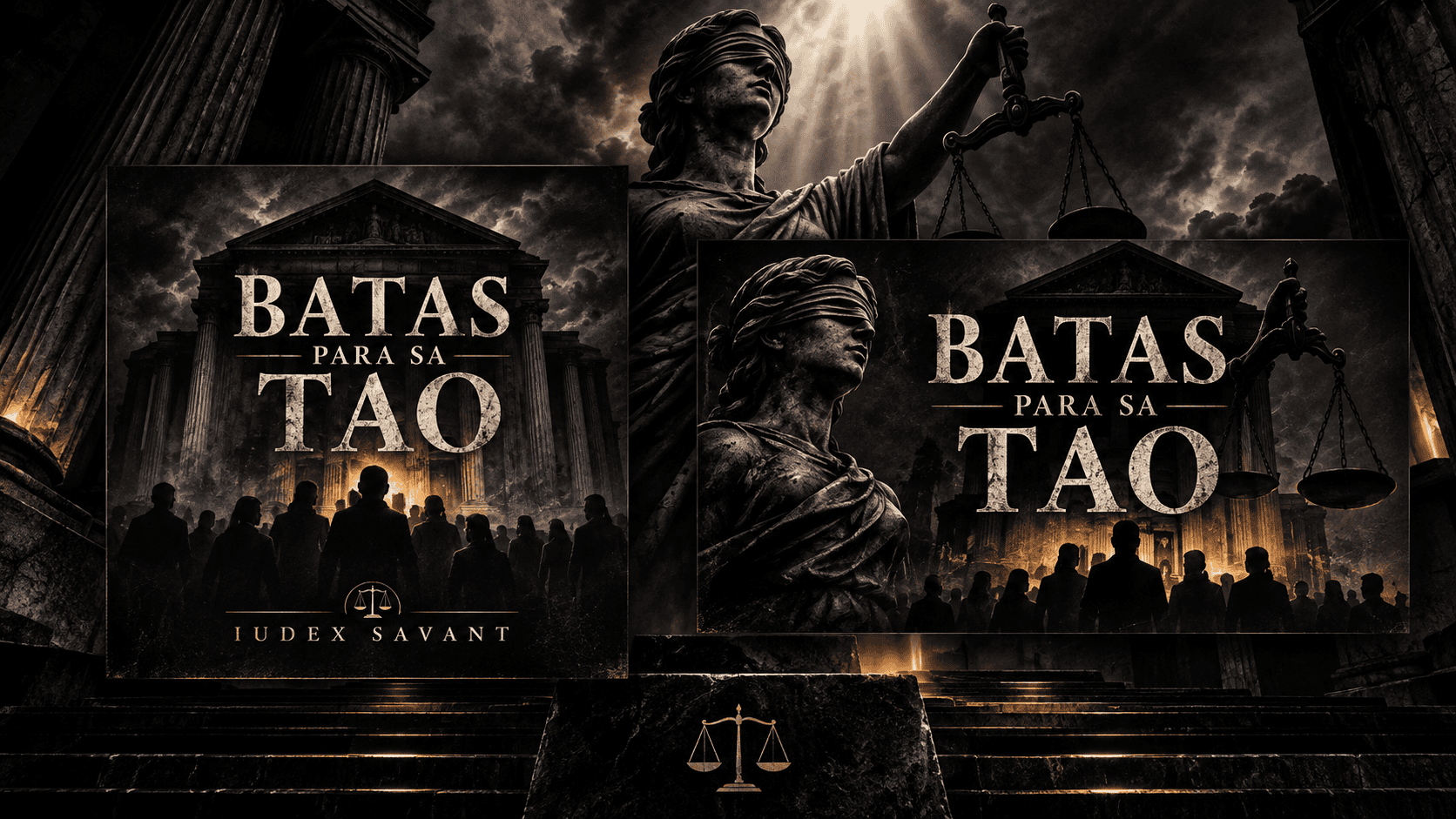
A law may be written with precision, approved through the proper process, and enforced by public authority. Yet these qualities alone do not make it just. The true value of law is measured by how it protects human dignity, preserves order, and gives every person a fair place in society.
This is the central message of “Batas Para sa Tao.” The song presents law not as a cold set of commands, but as an institution created for people. It reminds us that rules have a purpose. They exist to protect rights, define responsibilities, settle disputes, restrain abuse, and promote the common good.
Law must have authority, but authority must never lose sight of humanity.
Law Is More Than Written Words
Every legal system depends on written rules. Constitutions, statutes, regulations, and court decisions provide standards that guide conduct. Without clear rules, society would be governed by personal influence, fear, or force.
However, written language cannot anticipate every human situation. Life is often more complicated than the words found in a legal provision. Two cases may appear similar on paper but involve different motives, circumstances, and consequences. This is why the application of law requires more than the ability to read its text.
It also requires judgment.
The phrase “Batas Para sa Tao” expresses a basic legal truth: the law is a means, not an end in itself. Its purpose is not simply to punish violations or display the power of the State. It must help create a society where rights are respected, duties are performed, and wrongs are addressed through fair and peaceful processes.
When law becomes detached from people, it may remain technically valid while losing its moral direction.
Justice Must Understand Human Circumstances
Justice should be firm, but firmness does not require cruelty. A legal system can uphold accountability while still recognizing the realities of human life.
Courts regularly consider intention, good faith, age, capacity, relationship, surrounding conditions, and the effects of an act. These matters are not excuses automatically granted to anyone. They are relevant facts that help determine what justice requires in a particular case.
To listen is not to surrender the law. To understand is not to tolerate wrongdoing.
Reason and compassion can exist together. In fact, justice becomes more credible when decisions are based on both legal standards and a careful appreciation of the facts. A judgment that ignores human circumstances may follow the surface of the rule while failing to serve its deeper purpose.
The song captures this balance. It does not ask society to abandon discipline. Instead, it calls for a form of justice that knows when to be strict, when to protect, and when to recognize that fairness cannot always be achieved through automatic treatment.
Rights Must Be Matched by Responsibility
A society governed by law must protect individual rights. Freedom, property, dignity, privacy, equality, and due process cannot depend on personal favor. They must be secured by institutions that apply legal standards fairly.
But rights do not exist alone. They are accompanied by duties.
Freedom of expression does not erase responsibility for harmful conduct. Property rights do not justify the abuse of another person. Public authority does not permit officials to act beyond legal limits. Even the exercise of a valid right must respect the rights of others.
This relationship between rights and responsibility is one of the strongest ideas behind “Batas Para sa Tao.” The song does not present law as a shield for personal interest alone. It shows that every person is part of a wider community.
The law protects the individual, but it also asks the individual to respect the welfare of others.
Equality Is Not Blind Uniformity
The principle of equality is often understood to mean that everyone must be treated in exactly the same manner. That idea sounds fair, but strict uniformity may sometimes produce an unjust result.
People may stand before the law with different circumstances. Some have power, money, education, or influence. Others may struggle to understand legal procedures, obtain representation, or defend their rights. Treating unequal situations as though they were identical can preserve disadvantage instead of correcting it.
Real equality requires consistent standards, but it also demands attention to relevant differences.
This does not mean that the law should favor one person over another. It means that distinctions must be based on legitimate facts and lawful reasons, not prejudice, status, or personal connection. Fairness is achieved when similar cases are treated alike and genuine differences are considered with care.
A human-centered legal system does not remove the blindfold of justice to choose favorites. It ensures that the blindfold does not prevent justice from seeing the truth.
The Strength of Law Comes From Public Trust
Fear may compel obedience for a time, but it cannot create lasting respect for legal institutions.
People are more likely to follow the law when they believe that rules are clear, procedures are fair, and officials are accountable. They must be able to trust that disputes will be resolved according to evidence rather than influence. They must also believe that legal protection is available not only to the wealthy or powerful, but to every person who seeks justice.
Public trust is built slowly. It grows when government agencies explain their actions, courts remain independent, public officers observe legal limits, and decisions are applied without favoritism.
It is also easily damaged.
Selective enforcement, unexplained delay, corruption, and unequal access to justice can weaken confidence in the entire system. Once people begin to believe that law serves only those with power, obedience becomes based on fear or necessity rather than respect.
“Batas Para sa Tao” offers a different vision. It presents law as a public trust. Its force should come not merely from penalties, but from the belief that the legal system is worthy of obedience.
Compassion Does Not Weaken Justice
Compassion is sometimes mistaken for softness. In legal matters, it may even be viewed as a threat to consistency. Yet compassion, properly understood, is not the refusal to apply the law.
It is the willingness to see the person affected by it.
A compassionate legal system still imposes consequences when the evidence and the law require them. It does not erase responsibility or allow emotion to replace reason. What it does is prevent justice from becoming mechanical.
The law deals with real lives. A judgment may affect liberty, livelihood, property, family, reputation, and future opportunity. These consequences demand care. The decision-maker must remain faithful to legal principles while remembering that every case involves persons, not merely names written on a record.
Compassion becomes dangerous only when it ignores truth or creates favoritism. When guided by reason and equal standards, it strengthens justice by giving it a human purpose.
Law Must Protect the Weak Without Becoming Biased
The law should not be designed only for those who already know how to use it. Legal protection must also reach workers, families, victims, small property owners, accused persons, consumers, and communities that may lack influence.
Protecting the vulnerable does not mean deciding every case in their favor. Courts and public institutions must still examine evidence and apply the proper standard. The goal is not preference, but meaningful access.
A right that cannot be exercised is of little value. A remedy that is too costly, slow, or difficult to understand may exist in theory while remaining unavailable in practice.
For this reason, justice requires more than sound laws. It also requires accessible courts, competent legal assistance, clear procedures, and institutions that treat people with dignity.
The song’s message is persuasive because it does not separate legal principle from everyday life. It asks a practical question: whom does the law truly serve?
A Song About the Purpose of Justice
“Batas Para sa Tao” is not simply a song about statutes, courts, or public officials. It is about the reason legal systems exist.
Its message is relevant to judges, lawyers, lawmakers, public servants, students, workers, families, and ordinary citizens. Everyone is affected by law, even when they are not involved in a case. Rules shape employment, property, education, family relations, contracts, public safety, and personal freedom.
The song invites listeners to examine law beyond its formal appearance. A rule should not be respected merely because it carries a number, title, or penalty. It should also be measured by its purpose, its application, and its effect on the people it governs.
This does not encourage disobedience. On the contrary, it calls for a deeper respect for law—one founded on justice rather than fear.
The Law Must Remain Human
A strong legal system is not one that punishes the greatest number of people. It is one that prevents abuse, resolves conflict fairly, protects rights, and holds both citizens and authorities accountable.
The law must be stable, but it must not be indifferent. It must be firm, but never cruel. It must speak with authority while remaining open to reason, evidence, and human experience.
That is the lasting message of “Batas Para sa Tao.”
Law was not created so that people could become servants of empty rules. It was created so that freedom could be protected, responsibility could be defined, and justice could be pursued through order rather than force.
When the law serves people with fairness, wisdom, and dignity, society becomes stronger. When it forgets its purpose, even the most carefully written rule can become an instrument of injustice.
The challenge, therefore, is not only to demand obedience to the law. It is to ensure that the law remains worthy of the people it was created to serve.