

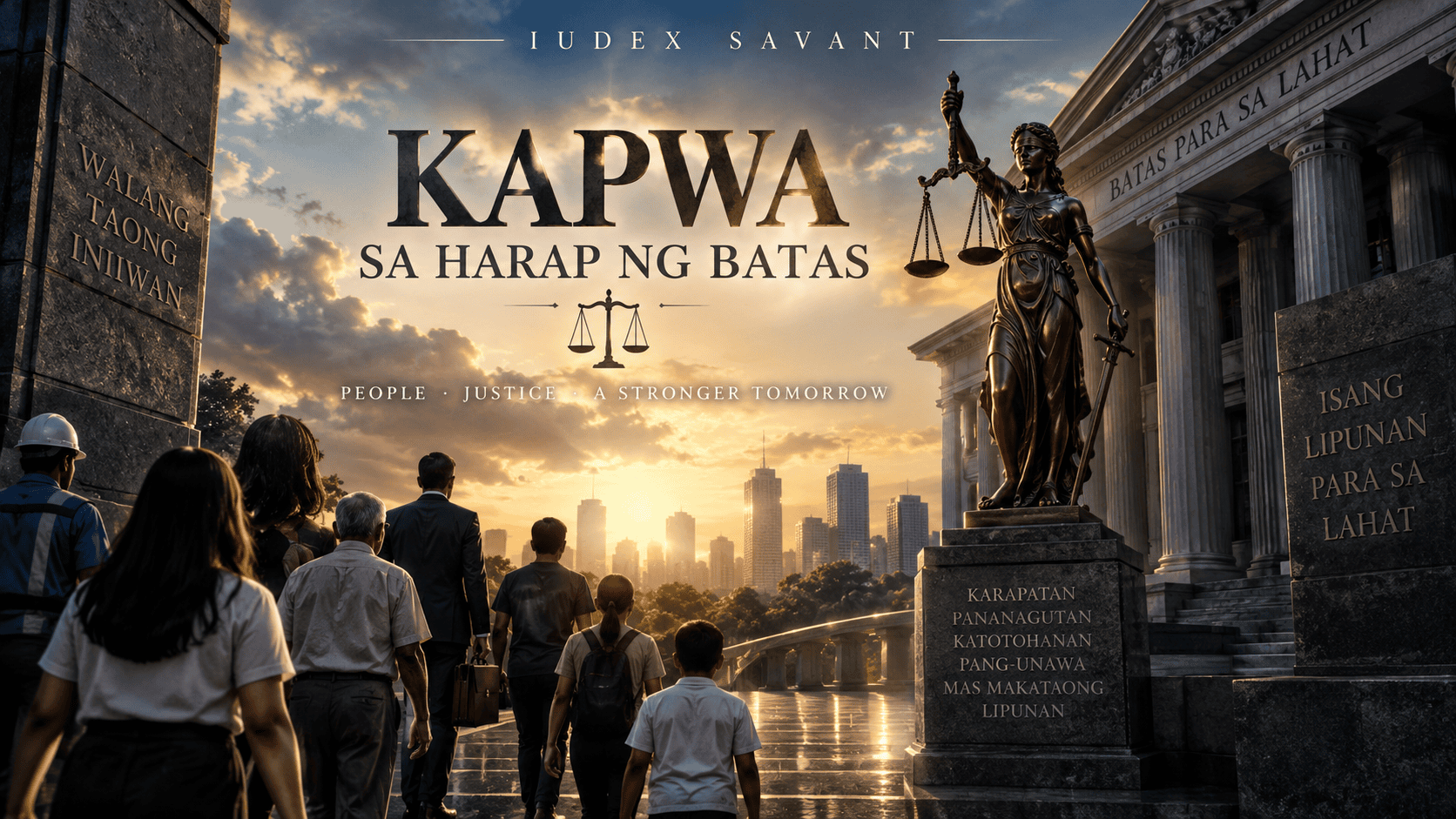
In every society, people speak about justice as if it is only a matter of rules, penalties, and court decisions. We often hear that the law must be equal for all. That principle is true and necessary. Yet equality before the law is only the beginning. The deeper question is this: How does the law treat the human person who stands before it?
That question lies at the heart of “Kapwa sa Harap ng Batas.” The song reflects on the meaning of justice in a way that is both legal and deeply human. It reminds us that while laws must be firm, they must also remain faithful to human dignity. In simple terms, the song says that every person who comes before the law must still be seen first as a fellow human being.
The Meaning Behind the Title
The word “kapwa” gives the song its moral center. In Filipino thought, kapwa is more than another person. It points to a shared humanity. It tells us that the one standing before us is not a stranger to be dismissed, but someone who shares the same human worth.
This gives the title “Kapwa sa Harap ng Batas” a powerful meaning. The law is not only about rights and duties. It is also about how we recognize one another while dealing with conflict, accusation, responsibility, and judgment. The song does not reject accountability. Instead, it insists that accountability must never erase dignity.
Justice Is More Than Equal Words on Paper
One of the strongest ideas in the song is that justice cannot stop at formal equality. It is not enough to say that the same rules apply to everyone. A law may look fair on paper, but fairness becomes incomplete when some people have no real way to reach protection, seek relief, or defend themselves.
This is a serious legal point expressed in simple language. The song recognizes that some people stand before the law with influence, education, resources, or social standing, while others come with fear, silence, and very little power. If justice is real, it must not only exist in legal texts. It must be reachable by ordinary people.
In this sense, the song speaks not only about equality, but about access to justice. It asks us to think about whether the law truly serves the public, especially those who are often unheard.
Rights Must Walk Together With Responsibility
Another strength of the song is its balance. It does not present justice as a one-sided concept. The message is not that everyone should only demand rights. Neither is the message that punishment alone defines order. Instead, the song places two legal ideas side by side: rights and responsibility.
This balanced view is important. A healthy legal order protects rights, but it also expects responsibility. A just society does not excuse wrongdoing simply because compassion is needed. At the same time, it does not become harsh and blind in the name of discipline. The song avoids both extremes. It argues that real justice requires fairness in both protection and accountability.
That legal and moral balance gives the song depth. It can speak to lawyers, law students, judges, public servants, and ordinary citizens alike.
Human Dignity Must Remain Intact
The emotional force of the song comes from its constant return to the value of human dignity. Some people come before the law as complainants. Others come as accused persons. Some appear strong because of wealth or position. Others seem weak because of poverty, fear, or social disadvantage. But the song reminds us that these labels do not remove personhood.
This is one of the song’s clearest truths. A person may be under investigation, in conflict, or in error, and yet still remain a person deserving of dignity. That idea does not weaken the law. On the contrary, it strengthens the moral credibility of justice.
A legal system that forgets dignity may still punish, but it cannot claim moral wisdom. The law must not treat people as mere cases, numbers, or obstacles. It must remember that behind every dispute is a human life.
The Law Should Not Be a Wall
One of the most memorable images in the song is the idea that the law should not become a wall that separates people. Rather, it should become a bridge. This is a simple but strong metaphor.
A wall keeps people out. It creates distance. It protects privilege. It can be used to silence those with little strength.
A bridge does the opposite. It connects. It allows access. It creates passage where there was once division.
When the song says that the law should be a bridge, it offers an ideal vision of justice. Law should not be an instrument of fear for the weak while remaining a shield for the powerful. It should be a means by which truth, fairness, and dignity become possible for all.
This message is especially relevant in our time, when many people feel that institutions are too distant from ordinary life. The song calls the law back to its public purpose.
Justice Must Listen Before It Judges
Another thoughtful feature of the song is its emphasis on listening. In legal work, listening is often underestimated. Yet no fair judgment is possible without it. Courts, lawyers, public officers, and institutions must listen not only to words, but also to the conditions behind them.
Listening matters because not all pain speaks loudly. Not all truth comes from power. Not all silence means consent or weakness. Sometimes people stand before the law carrying fear, shame, confusion, or a long history of exclusion. Justice must be able to hear that reality without surrendering its commitment to truth.
The song therefore speaks of conscience not as mere emotion, but as a moral faculty that knows how to listen. This is a sound legal insight. A legal system without conscience may become cold. A system with conscience does not abandon reason. It simply remembers that law exists for people.
There Is Room for Correction
One of the most meaningful parts of the song is its recognition that between right and wrong, there can still be understanding. This does not mean that the difference between right and wrong disappears. It means that justice can leave room for correction, learning, and return.
That is an important idea in both law and life. Not every response to wrongdoing must be rooted in humiliation. There are cases where the greater good is served by restoring people rather than merely condemning them. The song does not deny fault. It simply refuses to reduce justice to punishment alone.
This gives the song a restorative spirit. It sees justice not only as a force that declares error, but also as a process that can help a person become right again.
Why This Song Matters Today
“Kapwa sa Harap ng Batas” matters because it speaks to a concern many people feel but cannot always express clearly. Many know that laws exist. Many know that courts, procedures, and rights matter. But people also know that justice can feel distant when it is not lived with fairness and humanity.
This song gives voice to that tension. It speaks to the hope that the legal system can remain principled without becoming cruel, and compassionate without becoming weak. It calls for a justice that does not bow to the weight of names, status, or power. It asks that truth and conscience prevail.
For listeners who work in law, the song is a reminder of professional duty. For ordinary citizens, it is a reminder that justice belongs to the people. For everyone, it is a call to remember that the law serves its highest purpose when it protects both order and dignity.
Final Reflection
At its core, “Kapwa sa Harap ng Batas” is a song about seeing the human person clearly. It teaches that the law must do more than apply rules. It must recognize that every person standing before it carries dignity, rights, burdens, and the possibility of change.
That is why the song resonates beyond legal circles. Its message is simple, but not shallow. Justice begins not only when rules are enforced, but when people are treated with fairness, truth, and respect.
In the end, the song leaves us with a lasting reminder: before the law, we are not merely names, positions, or cases. We are kapwa—fellow human beings worthy of justice.