

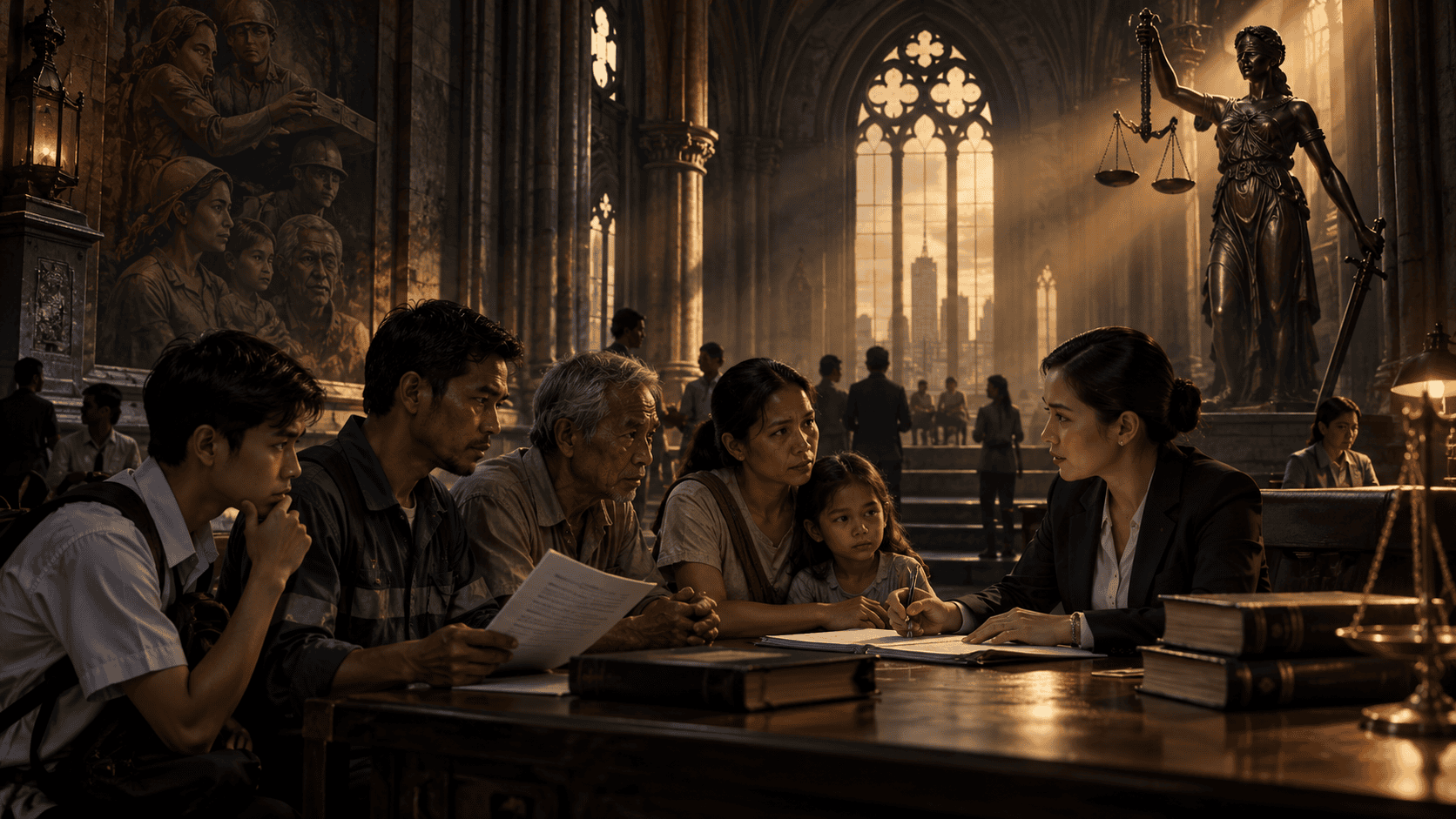
Law is often described through rules, rights, duties, penalties, and procedures. These are necessary. Without clear rules, the law becomes uncertain. Without procedure, power can become arbitrary. Yet law cannot end with the written word. Every legal rule eventually reaches a real person—a worker, a parent, a student, an accused, a complainant, a debtor, a victim, or a family trying to make sense of a difficult situation.
This is the idea behind “Batas na May Puso.” The song does not argue that compassion should replace law. It asks a more difficult question: Can justice remain firm without becoming indifferent to the people affected by it?
That question matters because the law is written in general terms with the objective of equal application to all, while human life is lived in particular circumstances. Two people may stand before the same rule but arrive there from very different conditions. Justice therefore demands more than mechanical application. It requires judgment, reason, proportion, and an honest understanding of the facts.
Law Must Be Firm, but It Must Also Understand
A legal system cannot function if every rule changes according to emotion. Courts, public officers, lawyers, and citizens need standards that can be applied consistently. Equality before the law would have little meaning if outcomes depended only on sympathy, influence, or personal preference. However, consistency is not the same as blindness.
A rule may apply equally to everyone on paper, while its effect may differ greatly in real life. A person with money, education, professional advice, and access to institutions can often navigate legal and administrative processes with relative ease. Another person may face the same process while carrying financial hardship, limited education, poor access to counsel, or responsibilities that cannot simply be set aside.
Recognizing those differences does not weaken the law. In many situations, it is part of applying the law properly.
This is where Batas na May Puso finds its voice. The “heart” in the title is not sentimentality. It is the capacity to see circumstances without abandoning principle.
Justice Is More Than Treating Everyone Exactly the Same
There is a difference between equal treatment and meaningful fairness.
Imagine two people standing before the same government office. Both are required to complete the same form. One understands every instruction. The other cannot easily read the language used in the document. Giving both the same sheet of paper may appear equal. But providing the second person with proper assistance does not create favoritism. It allows both persons a genuine opportunity to comply with the same requirement.
The same principle appears in many parts of public life. A child studying with complete resources does not face the same conditions as a child studying under poor lighting with limited materials. An elderly person navigating a courthouse may require assistance that a younger person does not. A worker seeking medicine for a family member may experience the cost of a prescription differently from someone with greater financial security.
The answer is not to discard standards. The answer is to apply them with an understanding of reality.
Justice cannot always be measured by asking whether everyone received exactly the same thing. Sometimes the more important question is whether everyone was given a fair opportunity to be heard, to participate, to comply, and to obtain the protection that the law promises.
The Human Being Behind Every Case
Legal documents can make human problems look remarkably simple.
A complaint has allegations. An answer contains admissions and denials. An information states an offense. A judgment identifies facts, issues, law, and disposition. Administrative forms reduce complicated lives into boxes, numbers, dates, and signatures. That structure is necessary. But the document is never the whole story.
Behind a case number may be a family losing a home, a worker defending a livelihood, a victim seeking accountability, or an accused person facing the power of the State. Behind a petition may be years of separation, uncertainty, sacrifice, or conflict. Behind a request for legal assistance may be someone who has never entered a courthouse before.
A legal system worthy of respect must be capable of recognizing those realities without allowing them to distort the law. That balance is difficult. It is also where judgment becomes most important.
Batas na May Puso speaks to that space between cold formalism and uncontrolled sympathy. The law must listen, but it must also reason. It may show mercy when the law allows mercy. It may consider circumstances when circumstances are legally relevant. It may protect the weak without assuming that weakness automatically makes a person right. It may punish wrongdoing without forgetting that punishment itself must remain lawful and proportionate.
Compassion Is Not the Opposite of Justice
Compassion is sometimes treated as though it necessarily conflicts with legal discipline. It does not.
Compassion becomes dangerous only when it ignores facts, excuses wrongdoing without legal basis, or gives one person an advantage merely because his story produces more sympathy. Properly understood, compassion is not a substitute for judgment. It is part of the discipline of seeing the full human situation before making a judgment.
A judge may understand suffering and still rule against the person who suffers. A lawyer may sympathize with a client while advising that the law does not support the desired result. A public officer may assist a citizen in understanding a process without changing the legal requirements. A prosecutor may pursue accountability while respecting the rights of the accused.
There is nothing inconsistent in these positions. The heart does not replace the mind. It reminds the mind what law is ultimately for.
A Legal System Must Be Accessible to Ordinary People
Justice loses part of its meaning when it can be understood only by those who already know how the system works.
Legal language has a purpose. Precision matters. Procedure matters. Technical rules often protect rights and prevent disorder. Yet institutions must also remember that most people who encounter the law are not lawyers.
For them, a courthouse can be intimidating. A government form can be confusing. A legal notice can create fear before its meaning is even understood. A person may have a valid right but fail to assert it simply because he does not know where to begin.
Access to justice therefore involves more than opening courthouse doors. It also involves understandable procedures, responsible legal assistance, fair opportunities to be heard, and institutions that do not treat confusion as a moral failure.
This concern runs throughout the imagery surrounding Batas na May Puso: workers waiting at service counters, families reading official notices, students travelling long distances, elderly citizens seeking directions, people asking lawyers for help, and ordinary Filipinos continuing their daily lives while carrying burdens that rarely appear in legal textbooks.
These are not side stories. They are the people for whom law exists.
The Danger of a Law Without Humanity
A legal system can become technically correct and still lose public trust.
When rules are applied without explanation, people experience law as command rather than justice. When procedure becomes more important than the purpose it was designed to serve, institutions can appear indifferent. When powerful people can easily obtain assistance while ordinary citizens struggle even to understand the process, formal equality begins to feel hollow.
This does not mean that every hardship justifies an exception. It means institutions should constantly examine whether their rules are serving justice or merely preserving routine.
The strongest legal systems are not those that abandon discipline in favor of emotion. They are those that can remain disciplined without becoming detached from human reality.
A law with heart is therefore not a weak law. It may actually demand more from those who apply it. They must understand both the rule and its purpose. They must separate genuine circumstances from convenient excuses. They must know when discretion is authorized and when it is not. Most of all, they must resist the temptation to treat people as mere files moving across a desk.
Justice Requires Both Principle and Humanity
There is a reason the idea behind Batas na May Puso cannot be reduced to a simple slogan. Justice is rarely simple.
There are situations where mercy is appropriate and situations where firmness is necessary. There are cases where equal treatment requires identical rules and others where fairness requires reasonable accommodation. There are moments when the law must protect a person from the majority and moments when it must protect society from the acts of an individual.
No song can resolve every tension within the legal system. Neither can a single legal principle. But the central idea remains worth defending: law should never become so concerned with rules that it forgets the people whom those rules are meant to govern and protect.
The challenge is not to choose between law and compassion. The challenge is to make sure that compassion operates within law, and that law remains conscious of human dignity. That is the meaning of Batas na May Puso.
It is not a call for softer justice. It is a call for better judgment—justice that is principled but not indifferent, firm but not cruel, consistent but not blind.
Because the highest purpose of law is not simply to produce decisions.
It is to make justice possible.