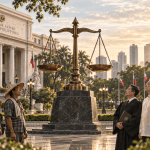


When Equal Treatment Is Not Enough
Everyone should be equal before the law.
It is one of the most important promises of any legal system. Wealth should not purchase a different kind of justice. Family name, social status, political influence, occupation, or connections should not determine whether a person receives protection from the law.
The powerful and the powerless must answer to the same legal order.However, there is a more difficult question behind this principle:
Does justice always mean giving everyone exactly the same treatment? The song “Karagdagan sa Batas” begins from this question.
It does not reject equality. On the contrary, it asks us to look more deeply at what equality requires when people enter society, government institutions, and courts from very different circumstances.
One person may have money, education, legal assistance, influence, transportation, and enough time to defend his interests.
Another may have none of these. Both may technically possess the same rights. But can both exercise those rights equally? That difference lies at the heart of “Karagdagan sa Batas.”
The song presents law not simply as a set of commands and penalties, but as an institution that must understand human circumstances. It argues that genuine fairness may sometimes require additional protection for those who begin with less.
- Not favoritism.
- Not exemption from responsibility.
- Not a different standard of truth.
Rather, a meaningful opportunity to stand before the law and be heard.
The Meaning Behind “Karagdagan sa Batas”
The central line of the song declares:
“Ang kapos sa buhay, dagdagan sa batas.”
Taken literally, the phrase may sound as though the poor should receive more rights than everyone else. That is not its message. The word “karagdagan” refers to the support necessary to make justice real.
- A person who cannot afford private counsel may need legal assistance.
- A child may need special protection because age and maturity affect the ability to protect one’s interests.
- A person with disability may require reasonable accommodation.
- A victim who fears retaliation may need measures that allow testimony to be given safely.
- An accused who does not understand the proceedings needs competent counsel and a clear explanation of legal rights.
- A worker dealing with an employer possessing far greater resources may need labor standards that cannot simply be waived.
These forms of protection are not necessarily privileges. They exist because people do not always enter legal relationships with equal power. The law recognizes this in many areas.
If equality meant only identical treatment in every circumstance, the legal system would have little reason to protect minors differently from adults, establish minimum labor standards, provide counsel for the indigent, regulate consumer transactions, or create special procedures for vulnerable persons.
The deeper purpose is not to make one group superior to another. It is to prevent disadvantage from destroying the practical value of a right.
Equality and Fairness Are Related, but They Are Not Always Identical
Consider two people asked to reach the same destination. One begins a few meters away. The other begins several kilometers behind.
Giving them exactly the same amount of time may be equal in form. Yet the circumstances are obviously different. Something similar happens under the law. Imagine two people receiving the same official notice.
One is educated, financially secure, and represented by counsel. Within hours, that person understands the consequences, gathers documents, and prepares a legal response.
The other is a minimum-wage worker who has never spoken to a lawyer and cannot afford to miss a day of work. The document may be written in technical language that he does not understand.
Both received the same notice. Formally, they were treated alike. Practically, however, they may not have received the same opportunity to protect themselves.
That distinction is important because law should not exist only in theory. Rights must be capable of being exercised.
A legal remedy that a person cannot realistically access may remain a right on paper while providing little protection in actual life. This is why the message of “Karagdagan sa Batas” goes beyond formal equality.
It asks whether the legal system gives ordinary people a genuine chance to use the rights that supposedly belong to everyone.
Formal Equality and Substantive Equality
Lawyers often distinguish between different ways of understanding equality. The first is formal equality.
Under this approach, similarly situated people should generally be governed by the same rules. Government should not arbitrarily favor one person over another. This principle is essential to the rule of law.
Yet, there is another concept: substantive equality. Substantive equality recognizes that applying exactly the same rule to persons in materially different circumstances may sometimes preserve rather than correct inequality.
This does not mean that government should guarantee identical outcomes. Nor does it mean that every disadvantage must produce a special legal entitlement. The idea is more modest.
The law may recognize relevant differences when those differences affect a person’s ability to enjoy a right, comply with an obligation, or participate meaningfully in a legal process.
We see this principle throughout modern legal systems. Labor law responds to unequal bargaining power between employers and workers.
Consumer protection laws address differences in knowledge, resources, and market power between businesses and ordinary purchasers.
Rules concerning minors recognize that children do not possess the same maturity and legal capacity as adults.
Legal aid programs acknowledge that justice should not depend entirely upon the ability to pay professional fees.
Procedural rights of accused persons recognize the enormous power of the State in criminal prosecution. These protections do not destroy equality. Properly applied, they help make equality meaningful.
Justice Must See the Person Behind the Case
The legal profession depends upon categories. People become plaintiffs, defendants, petitioners, respondents, complainants, accused, appellants, and appellees.
Their experiences are converted into allegations, admissions, denials, affidavits, testimonies, exhibits, and legal issues. This structure is necessary.
Courts cannot decide controversies merely according to emotion. Facts must be established. Evidence must be weighed. Procedural rules must be observed. Legal standards must control the outcome.
Nevertheless, the technical nature of law can sometimes make us forget something obvious: Behind every case title is a human story.
- An ejectment case may involve an owner asserting a lawful property right and a family facing the loss of the place they have called home.
- A labor dispute may determine whether a household can pay rent, tuition, or medical expenses.
- A criminal case may involve a victim seeking accountability and an accused whose liberty is in danger.
- A family case may determine where children will live and how relationships will continue after litigation ends.
- A debt case may involve a creditor who is legally entitled to payment and a debtor whose financial difficulties are real.
Recognizing these circumstances does not require a court to ignore the law. It simply prevents the legal process from becoming detached from the people whose lives it governs. This is one of the strongest ideas contained in “Karagdagan sa Batas.” The law must remain principled without becoming indifferent.
Compassion Does Not Mean Ignoring the Law
The word compassion sometimes creates discomfort in legal discussion. Law is expected to be rational. Courts are expected to decide according to evidence and legal rules rather than personal sympathy. That expectation is correct.
Compassion cannot replace proof. A sympathetic litigant does not automatically have a stronger case. Poverty cannot manufacture ownership. Hardship cannot erase a valid obligation.
A difficult personal history does not authorize a court to disregard the law. The victim of a wrong remains entitled to protection even when the person responsible is poor.
A wealthy party may still have a valid legal claim. A corporation can be legally correct. A landowner may be entitled to recover possession. A creditor may lawfully demand payment.
Justice cannot simply identify the weaker-looking party and declare that person the winner. That would not be justice at all. It would merely replace one form of unfairness with another.
The value of “Karagdagan sa Batas” lies in making a finer distinction. Compassion in law is not about predetermined outcomes. It is about making sure that people are able to participate fairly in the process.
The poor should not win because they are poor but neither should they lose merely because poverty prevented them from understanding or asserting a legitimate right.
Access to Justice Is Part of Justice Itself
A person may possess many legal rights and still find justice difficult to reach. You may consider the practical cost of pursuing a case.
- Transportation.
- Professional fees.
- Photocopying and documentation.
- Time away from work.
- Government requirements.
- Court appearances.
- Technical pleadings.
- Repeated postponements.
For someone with substantial resources, these may be inconveniences. For someone living from one payday to another, they may become barriers.
This is why access to justice must be understood as more than the existence of a courthouse. Access means that people can understand their rights.
- It means that procedures are not unnecessarily complicated.
- It means that those who cannot afford counsel have meaningful avenues for legal assistance where the law provides them.
- It means that citizens can approach institutions without unreasonable fear.
- It means that legal remedies are not rendered useless by delay, cost, intimidation, or needless technicality.
A legal system should therefore be judged not only by the quality of its statutes and judicial decisions. It should also be judged by a more practical question: Can ordinary people actually use it? That question is central to the philosophy of “Karagdagan sa Batas.” If the law promises justice to everyone but only the financially secure can effectively invoke it, the promise is incomplete.
Justice for the Poor Is Not Charity
Perhaps one of the most important ideas behind the song is that legal protection for disadvantaged persons should not be confused with charity. Charity is usually an act of generosity.
Justice concerns what a person is legally entitled to receive. When an indigent accused receives counsel because the law guarantees that protection, society is not merely being generous. A legal right is being respected.
When a worker receives wages required by law, an employer is not giving the employee a favor. The employer is complying with an obligation.
When a child receives legal protection appropriate to his or her age, the State is not simply being kind. It is applying principles developed to protect someone who cannot reasonably be treated in all respects as an adult.
When vulnerable individuals receive legally mandated accommodation or assistance, they are not automatically receiving special privilege. They may simply be receiving what is necessary to participate on a fairer basis.
This distinction gives the title “Karagdagan sa Batas” much of its force. The additional protection is not necessarily something outside justice. Sometimes it is what allows justice to function.
The Rule of Law Must Still Come First
There is, however, an important boundary. The desire to protect disadvantaged persons cannot justify abandoning the rule of law. Judges cannot rewrite statutes because a different outcome feels more humane. Courts cannot disregard jurisdiction. Evidence cannot be invented. Due process cannot be sacrificed.
A legally valid claim does not become invalid merely because its enforcement causes hardship. Government officials cannot exercise power according to personal preference simply because they believe they are pursuing a good purpose.
Law without limits becomes arbitrary. And arbitrary power eventually harms precisely the people who have the least ability to resist it.
The better understanding of “Karagdagan sa Batas” therefore combines two principles. First, law must remain faithful to legal rules, evidence, procedure, and institutional limits. Second, those rules should be interpreted and administered with awareness of human circumstances where the law permits such consideration.
Justice requires both structure and conscience. Structure protects against arbitrariness. Conscience protects against indifference. Neither should completely displace the other.
The Law Is More Than Punishment
For many people, law is associated mainly with prohibition and punishment.
- Do not steal.
- Do not injure another person.
- Do not defraud.
- Do not trespass.
- Do not violate lawful orders.
- Fulfill your obligations.
- Pay what is due.
These commands are necessary but law is also protective.
- It protects liberty against unlawful restraint.
- It protects property from wrongful interference.
- It protects workers from prohibited practices.
- It protects consumers against deception.
- It protects children and vulnerable persons against abuse.
- It protects accused persons through constitutional and procedural safeguards.
- It provides victims with remedies.
- It limits the power of government.
- It establishes ways to resolve disputes without violence.
Seen from this perspective, law is not merely a system that tells people what they cannot do. It is also a system designed to create conditions in which rights can exist. That protective role becomes particularly important for people who lack political, financial, or social power.
A wealthy person may sometimes protect an interest through influence, expertise, or resources. The disadvantaged often have only the law. That makes equal access to legal protection especially important.
Human Dignity Must Remain at the Center
The principle underlying many legal rights is human dignity. Dignity does not mean every litigant must succeed. It means every person should be treated as someone whose rights deserve consideration. The losing party is still entitled to a fair hearing.
The accused is still entitled to due process. The victim deserves to be heard. The poor should not be silenced by lack of resources. The wealthy remain subject to legal limits. Government officials must exercise authority within the law. Private persons must respect the rights of others.
These principles turn law from a collection of rules into a system of ordered justice. The real importance of “Karagdagan sa Batas” is therefore not merely economic. Its concern is dignity. A person’s lack of money, education, status, or influence should not make that person’s legal rights worth less.
A Message for Lawyers, Judges, and Law Students
The song also carries a message for people who work within the legal system. Lawyers spend years learning statutes, jurisprudence, procedure, evidence, and legal reasoning. Judges are required to decide according to law. Prosecutors must determine whether evidence supports prosecution. Defense counsel must protect the rights of the accused. Government lawyers must defend public interests within legal boundaries. Law students are trained to identify issues and apply rules. All of this is essential.
Nonetheless, technical knowledge should always remain connected to purpose. Why does due process matter? Because power must be restrained. Why must both sides be heard? Because justice cannot be based on only one version of events. Why does the law sometimes provide special protections for vulnerable groups? Because identical rules may not provide genuine equality where people face materially different circumstances. Why must courts remain independent? Because rights mean little if decisions can be purchased or dictated. Why must evidence matter? Because sympathy and accusation are not substitutes for proof.
Legal education becomes deeper when these questions accompany technical study. The best legal reasoning does not merely ask: What is the rule? It also asks: What value is the rule protecting? Those questions are not enemies. They belong together.
The Poor Do Not Need a Different Justice
A common misunderstanding about social justice is that it demands a separate legal standard for the poor. It does not.
The poor do not need a different truth. They do not need weaker standards of evidence. They do not need fabricated rights. They do not need guaranteed victory whenever they face someone wealthier.
What they need is access to the same justice that society promises everyone else. They need a fair opportunity to present a claim.
- A meaningful chance to defend themselves.
- Protection from coercion and abuse.
- Legal information they can understand.
- Procedures that do not become impossible solely because of poverty.
- A justice system that listens before it decides.
This distinction is important. The goal should not be to make law partial. It should be to prevent inequality outside the courtroom from determining everything that happens inside it.
What “Karagdagan” Really Means
The word “karagdagan” can therefore be understood in several ways. It can mean more access.
- More opportunity.
- More protection.
- More explanation.
- More legal assistance.
- More accommodation where circumstances genuinely require it.
- More safeguards against exploitation.
- More attention to barriers that prevent people from exercising rights already recognized by law.
Yet, it should never mean more truth for one side than the other. It should never mean automatic victory. It should never mean that one person’s dignity can be protected only by violating another person’s rights.
The challenge is to create a legal order in which those who begin with less can still stand before the law as full participants.
That is a much harder goal than simply declaring that everyone is equal. But it is also a more meaningful one.
What Does “Karagdagan sa Batas” Say About Social Justice?
At its core, “Karagdagan sa Batas” presents social justice as something more disciplined than charity and more principled than sympathy. Social justice does not ask the law to abandon neutrality.
It asks whether neutrality has real substance. It does not demand that everyone arrive at the same result. It asks whether people had a fair chance to reach that result. It does not treat poverty as innocence.
It recognizes poverty as a circumstance that may affect access, bargaining power, information, and vulnerability. It does not ask courts to become social welfare agencies. It reminds all legal institutions that law exists within society, and society is not perfectly equal.
That is why social justice and the rule of law should not automatically be treated as opposing ideas. Properly understood, each can strengthen the other.
Frequently Asked Questions About “Karagdagan sa Batas”
What is the main message of “Karagdagan sa Batas”?
The song argues that equal treatment alone does not always guarantee genuine fairness. People who face poverty, vulnerability, or limited access to legal resources may need additional protection or assistance so that their rights become meaningful in practice.
Does the song say that poor people should receive special treatment?
Not in the sense of automatic preference or guaranteed legal victory. Its message is that disadvantaged persons should receive the support necessary to participate fairly in the legal system.
Is compassion compatible with the rule of law?
Yes, provided compassion does not replace evidence, legal rules, or due process. A humane legal system may recognize difficult circumstances while remaining faithful to law.
Why is access to justice important?
Rights are meaningful only when people can realistically exercise them. Cost, lack of information, fear, delay, and inability to obtain assistance can prevent legal rights from becoming effective.
What is the difference between equality and fairness?
Equality often refers to applying the same standard to persons who are similarly situated. Fairness may require recognition of relevant differences when people do not begin from comparable circumstances.
Conclusion: Justice Must Be Equal, but It Must Also Be Real
“Karagdagan sa Batas” is ultimately a song about the kind of justice society should seek. The law must remain equal. It must remain impartial. It must respect evidence. It must protect due process. It must impose responsibility where responsibility belongs.
However, justice must also exist in the real world. Some people approach the law with resources, education, confidence, and professional assistance.
Others arrive frightened, uninformed, financially strained, or already burdened by circumstances beyond their control.
The legal system cannot erase every inequality in society. It cannot promise that everyone will begin life with the same opportunities. It cannot guarantee the same result for every person. But it can refuse to allow disadvantage to become an automatic sentence of defeat. It can provide safeguards. It can create remedies. It can make legal assistance available. It can protect people against abuse. It can simplify access where unnecessary complexity stands in the way. It can ensure that those without money or influence are still heard.
That is the deeper meaning of “Karagdagan sa Batas.” Equality does not always require giving everyone exactly the same thing. Sometimes fairness requires giving people what is reasonably necessary for them to exercise the same rights.
The poor do not need a different justice. They need meaningful access to the justice already promised to all. The vulnerable do not need the law to guarantee victory. They need assurance that vulnerability will not decide the case before they are even heard. The legal system does not have to choose between compassion and principle.
The better goal is a law that remains faithful to principle while understanding the human beings it governs. A law that is firm but not indifferent. A law that respects responsibility but recognizes circumstance. A law that protects rights without forgetting dignity.
And when the circumstances require it, a law willing to give those who have less enough protection to stand on equal ground. That is not favoritism. That is not weakness. That is not charity. That is justice.